Learn Chinese tones Trainer
How to Learn Chinese Tones efficiently — and stop awkward pronunciation mistakes
For many Chinese learners, Learn Chinese tones is one of the hardest parts of the journey — and one of the most important.
In English and other non-tonal languages, pitch usually only shows feeling. In Chinese, the tone is part of the word itself.
If your tones are off, native speakers get confused — or you land in an awkward joke. Below we unpack what is going on, then give you a focused drill.
Why Learn Chinese tones matters
The same pinyin syllable with a different tone becomes a completely different word.
Here is a classic pair: 沙 (shā) and 傻 (shǎ).
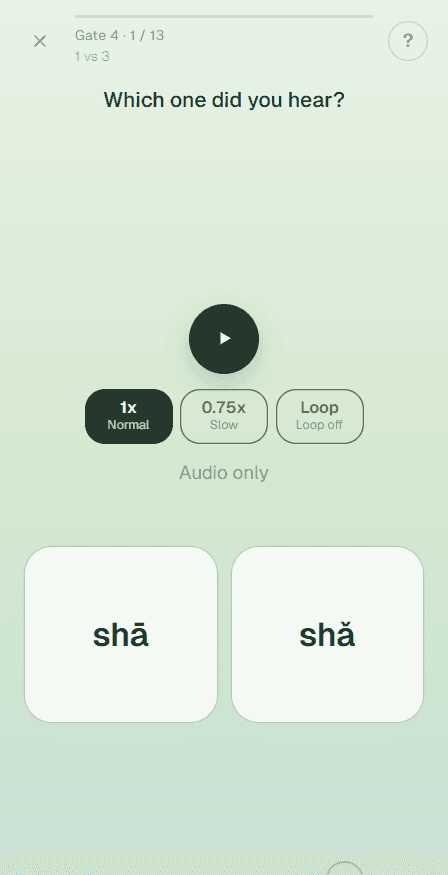
Tone 1 — 沙 (shā)
“sand” (沙子). The pitch stays high and level.
Tone 3 — 傻 (shǎ)
“fool” (傻瓜). The pitch dips low, then rises a little.
Imagine you mean “there is a lot of 沙 (shā) here,” but you say “there is a lot of 傻 (shǎ) here.” That is how awkward it gets.
Knowing the letters of pinyin is not enough — you have to tell the tones apart and say them.
The best way through: minimal-pair listening
When people Learn Chinese tones, they often drill “how to say it” and skip “how to hear it.” Hearing comes first.
If your ear cannot tell tone 1 from tone 3, your mouth cannot copy the difference.
The strongest drill is a minimal pair: two words that sound almost the same and differ only in tone. Listen, choose, then speak. Hearing and speaking together.
Start the drill on this page
This page has focused interactive practice. No rote charts — real listening and speaking, with native Mandarin audio instead of robotic TTS.
Core module: Tone 1 or Tone 3
This drill targets one of the easiest pairs to mix up: first tone versus third tone.
What you get
- Blind listen: a native clip of 沙 shā or 傻 shǎ. Later clips put the contrast in short sentences.
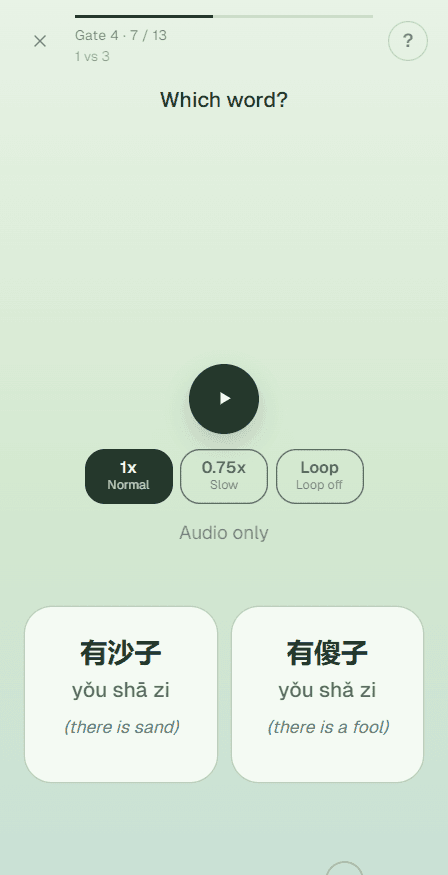
- Focus on pitch: a flat high pitch versus a low dip.
- Speed: 1x (Normal) or 0.75x (Slow) when the turn is hard to catch.
- Loop: replay until the shape sticks.
Your turn — practice below
Scroll to the trainer under this article. Tap the round play button, listen, then choose 沙 shā or 傻 shǎ.