How do I overcome the inability to hear different Mandarin tones?
You aren’t “tone deaf,” and memorizing tone charts won’t fix it. Here is how to train a non-tonal ear to finally catch Mandarin pitch—one contrast at a time.
People insist two words are clearly different. You replay them, and they still sound the same.
This isn’t a memory problem. If you grew up speaking English or another non-tonal language, pitch only signaled attitude—like a question or surprise. In Mandarin, pitch is the word. Because your ear was never asked to sort words that way, the difference stays invisible—and you cannot pronounce a shape you cannot yet hear.
Why the usual advice fails
- Tone charts (mā, má, mǎ, mà): Naming four drawings on a chart doesn't help you catch a rapid pitch drop in real speech.
- “Just listen more”: Dumping all four tones and tone sandhi on an untrained ear at full speed only creates noise.
- Speaking too early: If you cannot hear the fall, you cannot tell when your own voice misses it.
What actually opens your ear
You have to isolate one contrast until it stops being invisible.
Right below, we’ve stripped everything down to a single pair—Tone 1 vs. Tone 4—where consonants won't save you (miss the fall, and 买花 mǎi huā, “buy flowers,” becomes 买画 mǎi huà, “buy a painting”):
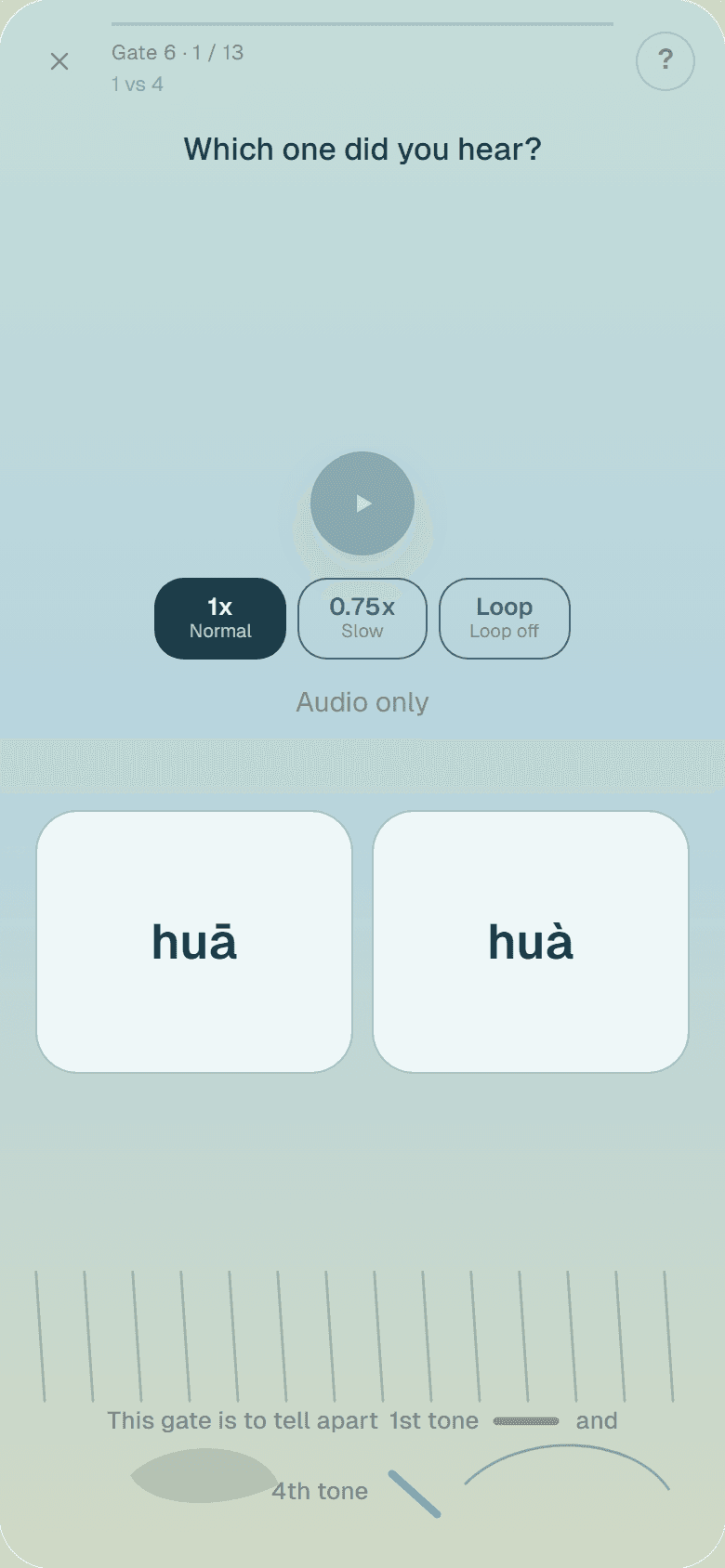
Tone 1 — 花 (huā), “flower”
High and level.
Tone 4 — 画 (huà), “painting”
Falls from high to low.
Instead of memorizing rules, train your ear in three steps using the player below:
- Spot the difference first: Listen to native clips of 花 (huā) and 画 (huà)—first alone, then in short phrases—and guess which one you heard.
- Slow down the drop: If they still blur together, hit 0.75x or Loop until the pitch fall is something you can clearly point at.
- Check your own voice: Once your ear catches it reliably, record yourself and play it right next to the native clip. No arbitrary scores—the only check is whether you can hear your own miss.
Tap the round Play button below to test your ear