How to pronounce Chinese tones
Hear the pitch shape first — then say it without mixing up the word
Searching How to pronounce Chinese tones usually means one thing: you can read the pinyin marks, but the word still comes out wrong.
In English, pitch mostly shows feeling. In Mandarin, the tone is part of the word. Say the wrong shape and you name a different word.
Charts of mā má mǎ mà do not fix that by themselves. Hear one real contrast, then match a native clip. The drill sits under this article.
Why pronunciation fails when the tone fails
How to pronounce Chinese tones is not “speak louder on the vowel.” It is whether the pitch dips or falls while the consonants stay the same.
This gate drills tone 3 versus tone 4: 饱 (bǎo) and 爆 (bào).
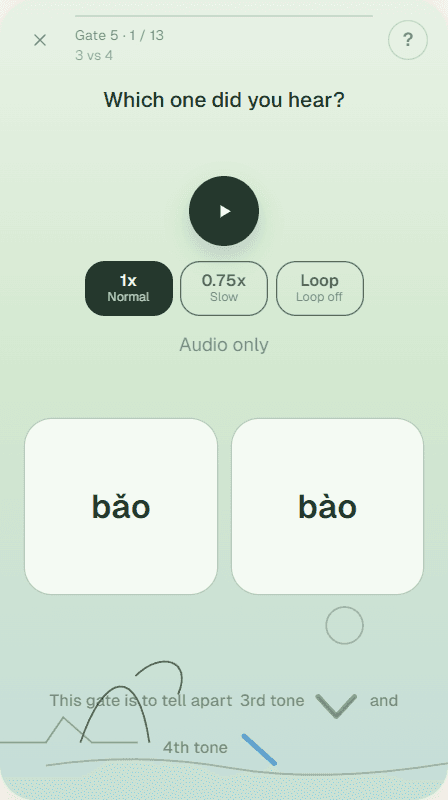
Tone 3 — 饱 (bǎo)
“full.” Low dip. In a word: 吃饱 chī bǎo.
Tone 4 — 爆 (bào)
“to burst.” Sharp fall. In a word: 吃爆 chī bào.
You mean 我吃饱了 wǒ chī bǎo le (“I'm full”), but a fourth-tone slip makes 我吃爆了 wǒ chī bào le. Same letters — different word.
That is why How to pronounce Chinese tones has to include hearing and saying, not only reading tone marks.
Hear first, then say
Many learners jump straight to speaking. If your ear cannot tell a low dip from a sharp fall, your mouth will keep guessing.
Listen: a native clip plays 饱 bǎo or 爆 bào — later inside short phrases. Pick what you heard. Use 0.75x or Loop when needed.
Speak: record yourself, play the model, check where your pitch drifted. No score. You say the characters, 吃饱 chī bǎo, and 我吃饱了 wǒ chī bǎo le.
The drill on this page
Below is a practice gate for this contrast — native audio, not robotic TTS. One pair only: tone 3 versus tone 4.
Core module: Tone 3 or Tone 4
What you get
- Blind listen: native 饱 bǎo or 爆 bào, including short sentences.
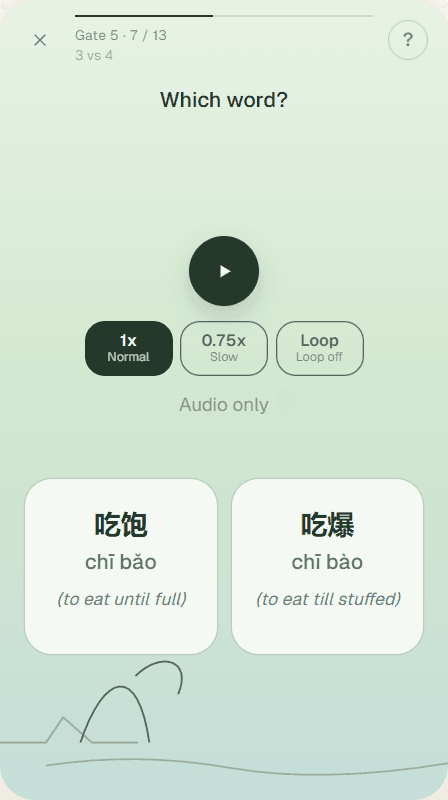
- Focus on pitch: a low dip (tone 3) versus a sharp fall (tone 4).
- Speed: 1x (Normal) or 0.75x (Slow).
- Loop: replay until the shape sticks, then say it on the speaking steps.
Your turn — practice below
Scroll to the trainer under this article. Tap Play, choose 饱 bǎo or 爆 bào, then follow the speaking prompts.