4 tones in Chinese
Naming the four Chinese tones is not the same as using them. Here is how to stop treating Mandarin pitch like a chart you finish once.
Search “4 tones in Chinese” and you get the same poster: four tone marks over mā, má, mǎ, mà. You memorize the shapes, recite Chinese tones on ma, and feel done.
Then a real word shows up. 杯子 bēi zi and 被子 bèi zi share the same letters; only the Chinese pinyin tone changes. Knowing the names of Chinese language tones does not decide which one you actually said—or heard.
Why the usual advice fails
- Finish the mā chart, move on: Chinese pinyin 4 tones on one syllable train labels. They do not train one contrast inside a word that changes meaning.
- Drill all tones in Mandarin Chinese at once: Stacking the second tone rise with the fourth tone fall (and everything else) before any pair is solid just blurs the marks you already “know.”
- Treat tone marks as vocabulary: A tone mark on paper is not proof you can catch that pitch when the word is spoken at normal speed.
What actually sticks
Keep the idea of four tones. Drop the idea that one chart covers them. Pick a single pair and stay there until the change of meaning is obvious.
Right below is Tone 1 vs. Tone 4 only. Miss the fall and 杯子 bēi zi, “cup,” becomes 被子 bèi zi, “quilt”:
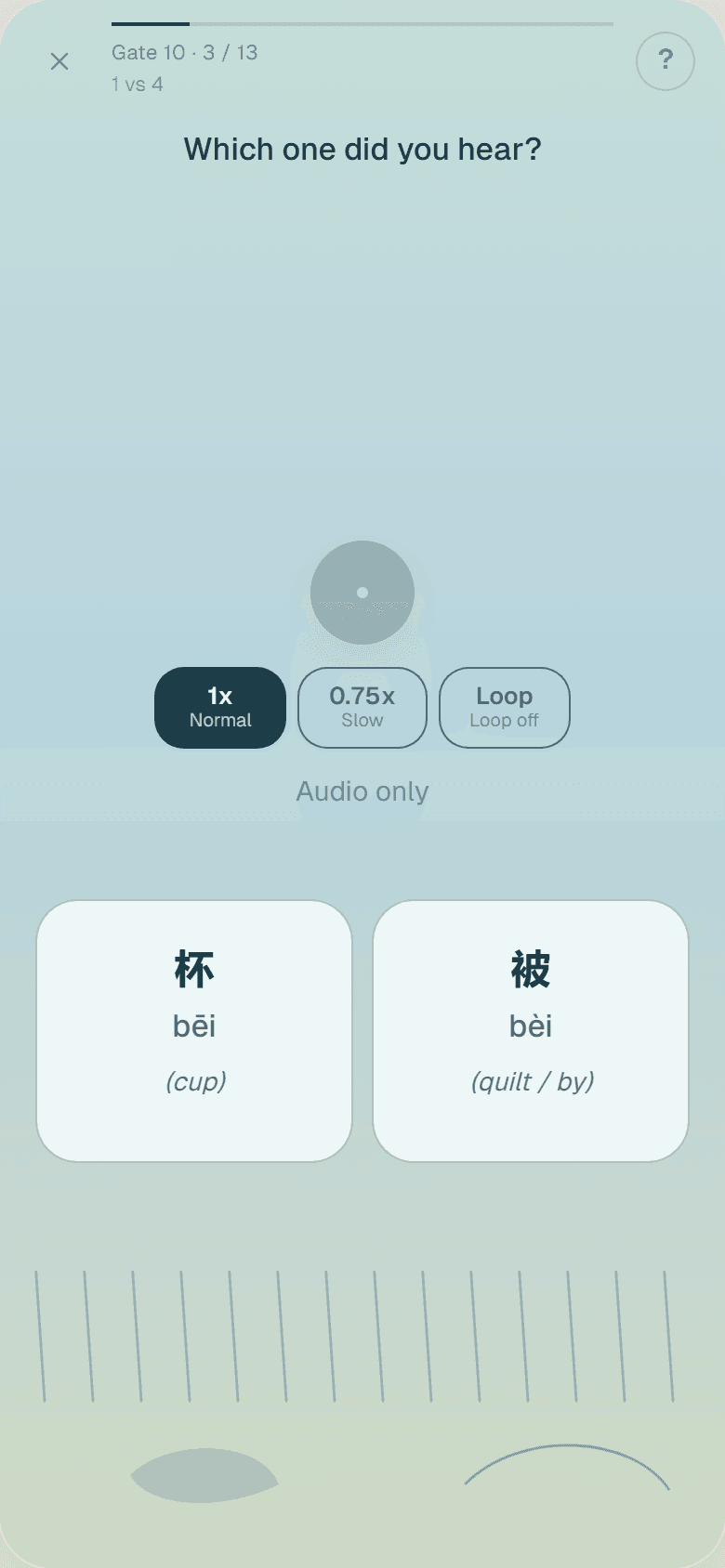
Tone 1 — 杯 (bēi), “cup”
High and level.
Tone 4 — 被 (bèi), in 被子 “quilt”
Falls from high to low—the classic fourth tone Chinese drop.
Three steps on the player below—still one pair, not another full tone chart:
- Spot the difference first: Listen to native clips of 杯 (bēi) and 被 (bèi)—first alone, then in short phrases—and guess which one you heard.
- Slow down the drop: If the marks still feel the same in speech, hit 0.75x or Loop until the fall is something you can point at.
- Check your own voice: Record yourself next to the native clip. No score—only whether you can hear if you kept level or fell.
Tap the round Play button below to test one pair